
Greenville County Court Records After Arrest
A Greenville County jail arrest starts in custody, but the court record is built through the court system. After a person is arrested, the Greenville County Detention Center creates the jail booking record. That record may show charges and bond for local custody purposes. The next stage is court-facing: first appearance, prosecutor review, charging decisions, docket events, and eventual disposition. The public path for formal case information is the Greenville County Public Index, which is the local South Carolina Judicial Department index route.
The distinction is important because a jail booking charge can be preliminary. The Thirteenth Judicial Circuit Solicitor's Office handles many criminal prosecutions in Greenville County, and the Solicitor may file, amend, reduce, dismiss, or present charges differently from the jail intake wording. For custody and bond on a current detainee, use Greenville County jail inmate records. For booking photos, use the jail mugshots page rather than a court index, since court records generally track filings and case events instead of photos.
The Public Index was also blocked from terminal inspection by an anti-scraping page during research. That means field labels and sample case screens are inspection-limited here. The official portal is still the correct source for public case lookup in a live browser.
Search Greenville County Court Records
Start with the court index after the jail booking is known or after enough time has passed for a filed case to appear. Search by defendant name when a case number is not known. If the person has multiple cases, compare charge names, arrest timing, court, and status. Do not assume the first similar name result is the same person.
- Open the official Greenville County Public Index in a regular browser session.
- Search by defendant name or case number, depending on what is known from the jail roster or paperwork.
- Open the matching case and review filed charges, court type, case status, hearings, and disposition.
- Compare the court charge list with the jail booking charge list, because they may differ after prosecutor review.
- For older, sealed, expunged, juvenile, or unavailable records, contact the Clerk of Court or use the proper records request channel.
The Greenville County Clerk of Court is the routing office for court records and public index access. The Public Index image below comes from the official court portal capture in the manifest.
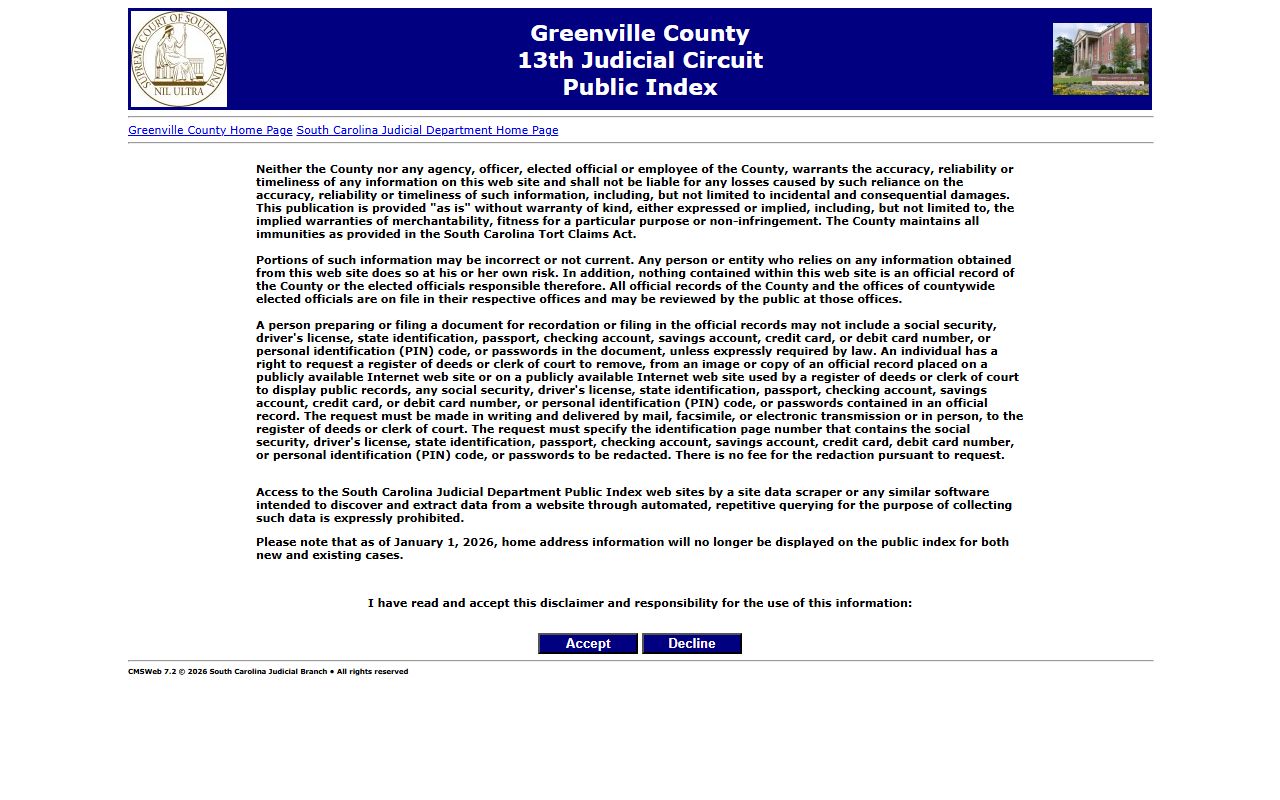
The image shows why live browser access is the right method for court-record inspection, while automated terminal scraping is not a reliable way to read Greenville County case fields.
Greenville County Court Search Fields
The court index field inventory is limited by the anti-scraping response found during research. The table preserves the known access path without inventing exact labels that were not visible in the terminal environment.
| Field Label | Type | Required | Notes |
|---|---|---|---|
| Case search or Public Index | Web portal | Unspecified | Use the official Greenville County Public Index in a browser. |
| Defendant name | Text | Likely optional search criterion | Not confirmed from terminal source. |
| Case number | Text | Likely optional search criterion | Use when known from court papers, bond papers, or a prior lookup. |
| Court type | Dropdown or tab | Unspecified | Confirm exact Greenville options in the live portal. |
| Search or submit | Button | n/a | Button label not confirmed from terminal inspection. |
Charges Filed After Arrest
After a Greenville County arrest, a charging document or court filing moves the matter from jail intake into the case record. South Carolina practice can involve magistrate-level proceedings, General Sessions prosecution, warrants, indictments, and other filings depending on the offense. The plain-language point is simple: the jail roster can show why someone was booked, while the court case shows what charges the court is tracking.
| Document | Who Uses It | What It Does |
|---|---|---|
| Complaint or warrant-based charge | Law enforcement, magistrate process, or prosecution | States the alleged offense that supports arrest or case initiation. |
| Information or prosecutor filing | Solicitor or prosecutor | Reflects charging decisions after review of the arrest facts. |
| Indictment | Grand jury and prosecution | Formal charging route for serious charges in higher criminal court. |
These labels are not a promise that each Greenville County case will use every document. They show why a case can look different in the Public Index than it did on the jail roster the day of arrest.
Greenville County Solicitor Role
South Carolina uses Solicitors rather than District Attorneys. Greenville County is in the Thirteenth Judicial Circuit, which covers Greenville and Pickens counties. The Thirteenth Judicial Circuit Solicitor's Office is the local prosecutor office for many criminal cases after arrest. Research confirms that Cindy S. Crick became Solicitor effective June 6, 2025, after Governor Henry McMaster appointed her following Walter Wilkins's resignation.
The Solicitor's Office is relevant because it explains why court records after a jail arrest are not just a copy of the booking sheet. Prosecutor review can lead to amended counts, reduced charges, dismissed counts, diversion, plea negotiations, or indictment decisions. Victims and witnesses may also interact with the Solicitor's Office, while custody notification can be tracked separately through VINELink where available.
The official Solicitor's Office page is shown in the captured image below.
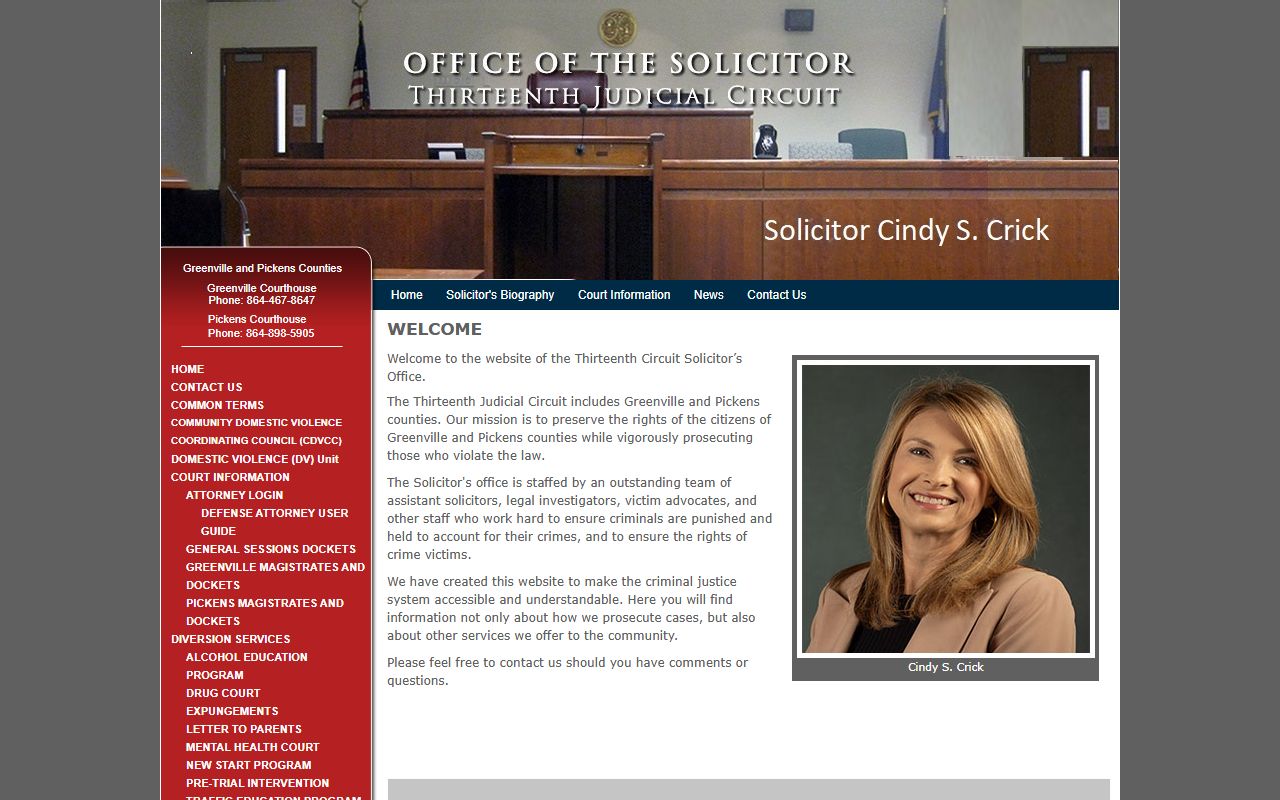
Use that office for prosecution context, not for immediate jail housing or release-date questions.
Greenville County Charge Status
Charge status terms describe where a filed charge stands. They do not all mean guilt, and some are procedural. A pending charge is still open. A dismissed charge has ended without conviction. A nolle prosequi entry means the prosecutor declines to proceed. A disposed case has an outcome entered by the court.
| Status | What It Means | How to Read It |
|---|---|---|
| Pending | The case or charge remains open. | Check future court dates and bond conditions. |
| Amended | Charge language or count changed. | Compare current court record with the original jail charge. |
| Reduced | The charge level or offense was lowered. | Often appears after prosecutor review or resolution. |
| Dismissed | The charge ended without conviction. | It may still have a public record unless expunged or restricted. |
| Nolle prosequi | The prosecutor declined to proceed. | Commonly shortened as nol pros or nolle pros in court records. |
| Disposed | The court entered an outcome. | Read the disposition details before drawing conclusions. |
Bond After Greenville County Arrest
Bond sits between the jail record and the court record. Greenville County says bond amounts can be found through the Inmate Search option and are listed for individual charges. It also says a temporary bond means the inmate has not appeared before a judge to be arraigned and no bond has been set. That is a timing term, not proof that release is denied forever.
Release also depends on judicial authorization reaching the jail. Greenville County's FAQ states that after a judicial release is received, the Detention Center's goal is release within four hours, subject to emergencies and other exigent circumstances. A hold, warrant, probation matter, federal issue, or other-agency detainer can still block release even after one local bond is resolved.
| Bond Term | Greenville County Meaning |
|---|---|
| Temporary bond | No judge or arraignment yet, and no bond has been set. |
| Cash bond | Money posted directly if allowed by court conditions. |
| Surety bond | Commercial bonding-company route when permitted. |
| Personal recognizance | Release on a promise to appear if ordered by the court. |
| No-bond hold | No release bond is available for that charge or hold until a court or agency changes it. |
Warrants and Court Records
A warrant can lead to an arrest and later to a Greenville County court record. Sheriff Hobart Lewis's office includes GCSO Warrant Services, but no official searchable active-warrant database was confirmed in the research. For warrant questions, the official phone route is the warrant office at 864-467-5241 during business hours, with message capability. After-hours or time-sensitive warrant information can route through dispatch at 864-271-5210, option 8. Emergencies still belong with 911.
Bench warrants can also arise from missed court, probation issues, or another jurisdiction. That is why court records after an arrest may need both the Public Index and direct warrant-office contact. If a warrant is served and the person is booked, the county jail roster becomes the custody lookup. If the warrant remains only a court or agency matter, the jail roster may not show a current inmate.
Charges Versus Convictions
A charge is an accusation. A conviction is a court outcome after a guilty plea, verdict, or other adjudication. Greenville County court records after a jail arrest may show both charged counts and final dispositions, but those are not the same thing.
| Point | Charge | Conviction |
|---|---|---|
| Stage | After arrest, warrant, indictment, or prosecutor filing. | After plea, verdict, or court finding. |
| Meaning | Alleged offense. | Final or entered guilt outcome. |
| Record reading | May be pending, amended, reduced, or dismissed. | Read sentence and disposition details. |
| Use caution | Not proof of guilt. | Still must be read with date, court, and exact charge. |
Sealed and Expunged Records
South Carolina law includes criminal procedure provisions related to expungement in Title 17, Chapter 1. A sealed or expunged record issue can affect whether a Greenville County court record after an arrest remains public, appears in an index, or requires official court routing. Eligibility depends on the charge, disposition, prior history, and the specific statute or court order.
| Point | Sealed or Restricted | Expunged |
|---|---|---|
| Public visibility | Hidden from ordinary public access or limited by order. | Removed or treated as cleared under the order and statute. |
| Record source | Court or agency may still retain limited access. | Follow the expungement order and official court process. |
| Eligibility | Depends on law and court order. | Depends on disposition, offense, and South Carolina procedure. |
| Practical next step | Ask the court clerk about the specific case. | Use the court or Solicitor expungement path, not a mugshot site. |
Juvenile matters, active investigations, sensitive victim information, and exempt law-enforcement material may also be withheld or redacted under South Carolina public-records rules.
Greenville County Court Access Limits
South Carolina FOIA, Title 30, Chapter 4, governs access to public records from public bodies, subject to exemptions. Section 30-4-30 covers inspection or copying procedures for nonexempt public records. Section 30-4-40 lists exemptions that can limit release, including law-enforcement, privacy, investigatory, and other protected material.
For sheriff or law-enforcement records connected to an arrest, the GCSO Public Records Center is the formal request portal. Greenville County Public Safety also identifies an in-person Public Records Office at the Law Enforcement Center, 4 McGee Street. Fees and advance payment may apply when the county has to search, copy, or produce records.
Important: Court records after arrest must not be used for employment, credit, housing, insurance, or other FCRA-covered decisions from this source.